ECPGPlus overview
EDB enhanced ECPG (the PostgreSQL precompiler) to create ECPGPlus. ECPGPlus is a Pro*C-compatible version of the PostgreSQL C precompiler. ECPGPlus translates a program that combines C code and embedded SQL statements into an equivalent C program. As it performs the translation, ECPGPlus verifies that the syntax of each SQL construct is correct.
The following diagram charts the path of a program containing embedded SQL statements as it’s compiled into an executable:
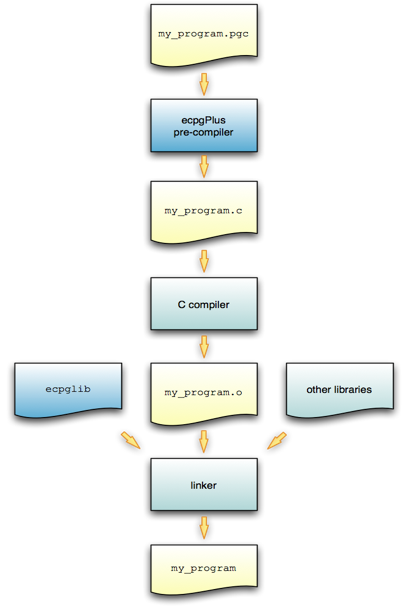
Compilation of a program containing embedded SQL statements
Compilation of a program containing embedded SQL statements
To produce an executable from a C program that contains embedded SQL statements:
Pass the program (
my_program.pgcin the diagram) to the ECPGPlus precompiler. ECPGPlus translates each SQL statement inmy_program.pgcinto C code that calls theecpglibAPI and produces a C program (my_program.c).Pass the C program to a C compiler. The C compiler generates an object file (
my_program.o).Pass the object file (
my_program.o) as well as theecpgliblibrary file and any other required libraries to the linker, which in turn produces the executable (my_program).
While the ECPGPlus preprocessor validates the syntax of each SQL
statement, it can’t validate the semantics. For example, the
preprocessor confirms that an INSERT statement is syntactically
correct, but it can’t confirm that the table mentioned in the INSERT
statement exists.
Behind the scenes
A client application contains a mix of C code and SQL code made up of the following elements:
C preprocessor directives
C declarations (variables, types, functions, …)
C definitions (variables, types, functions, …)
SQL preprocessor directives
SQL statements
For example:
1 #include <stdio.h>
2 EXEC SQL INCLUDE sqlca;
3
4 extern void printInt(char *label, int val);
5 extern void printStr(char *label, char *val);
6 extern void printFloat(char *label, float val);
7
8 void displayCustomer(int custNumber)
9 {
10  EXEC SQL BEGIN DECLARE SECTION;
11    VARCHAR custName[50];
12    float custBalance;
13    int custID = custNumber;
14  EXEC SQL END DECLARE SECTION;
15
16  EXEC SQL SELECT name, balance
17    INTO :custName, :custBalance
18    FROM customer
19    WHERE id = :custID;
20
21  printInt("ID", custID);
22  printStr("Name", custName);
23  printFloat("Balance", custBalance);
24 }
In this code fragment:
Line 1 specifies a directive to the C preprocessor.
C preprocessor directives can be interpreted or ignored. The option is
controlled by a command line option (-C PROC ) entered when you
invoke ECPGPlus. In either case, ECPGPlus copies each C preprocessor
directive to the output file (4) without change. Any C preprocessor
directive found in the source file appears in the output file.
Line 2 specifies a directive to the SQL preprocessor.
SQL preprocessor directives are interpreted by the ECPGPlus preprocessor and aren’t copied to the output file.
Lines 4 through 6 contain C declarations.
C declarations are copied to the output file without change, except that
each VARCHAR declaration is translated into an equivalent struct
declaration.
Lines 10 through 14 contain an embedded-SQL declaration section.
C variables that you refer to in SQL code are known as host variables.
If you invoke the ECPGPlus preprocessor in Pro*C mode (-C PROC ),
you can refer to any C variable in a SQL statement. Otherwise you must
declare each host variable in a BEGIN/END DECLARATION SECTION pair.
Lines 16 through 19 contain a SQL statement.
SQL statements are translated into calls to the ECPGPlus runtime library.
Lines 21 through 23 contain C code.
C code is copied to the output file without change.
Prefix any SQL statement with EXEC SQL . The SQL statement extends
to the next (unquoted) semicolon. For example:
printf(“Updating employee salaries\n”);

EXEC SQL UPDATE emp SET sal = sal * 1.25;
EXEC SQL COMMIT;

printf(“Employee salaries updated\n”);
When the preprocessor encounters this code fragment, it passes the C
code (the first line and the last line) to the output file without
translation and converts each EXEC SQL statement into a call to an
ecpglib function. The result is similar to the following:
printf("Updating employee salaries\n");

{
  ECPGdo( __LINE__, 0, 1, NULL, 0, ECPGst_normal,
         "update emp set sal = sal * 1.25",
         ECPGt_EOIT, ECPGt_EORT);
}

{
  ECPGtrans(__LINE__, NULL, "commit");
}

printf(“Employee salaries updated\n”);
Installation and configuration
On Windows, ECPGPlus is installed by the EDB Postgres Advanced Server
installation wizard as part of the Database Server component. On Linux,
install with the edb-asxx-server-devel RPM package, where xx is
the EDB Postgres Advanced Server version number. By default, the
executable is located on Windows in:
C:\Program Files\edb\as14\bin
On Linux, it’s located in:
/usr/edb/as14/bin
When invoking the ECPGPlus compiler, the executable must be in your
search path (%PATH% on Windows, $PATH on Linux). For example,
the following commands set the search path to include the directory that
holds the ECPGPlus executable file ecpg .
On Windows:
set EDB_PATH=C:\Program Files\edb\as14\bin
set PATH=%EDB_PATH%;%PATH%
On Linux:
export EDB_PATH==/usr/edb/as14/bin
export PATH=$EDB_PATH:$PATH
Constructing a makefile
A makefile contains a set of instructions that tell the make utility how to transform a program written in C that contains embedded SQL into a C program. To try the examples, you need:
A C compiler (and linker)
The make utility
ECPGPlus preprocessor and library
A makefile that contains instructions for ECPGPlus
The following code is an example of a makefile for the samples included
in this documentation. To use the sample code, save it in a file named
makefile in the directory that contains the source code file.
INCLUDES = -I$(shell pg_config --includedir)
LIBPATH = -L $(shell pg_config --libdir)
CFLAGS += $(INCLUDES) -g
LDFLAGS += -g
LDLIBS += $(LIBPATH) -lecpg -lpq

.SUFFIXES: .pgc,.pc

.pgc.c:
     ecpg -c $(INCLUDES) $?

.pc.c:
     ecpg -C PROC -c $(INCLUDES) $?
The first two lines use the pg_config program to locate the
necessary header files and library directories:
INCLUDES = -I$(shell pg_config --includedir)
LIBPATH = -L $(shell pg_config --libdir)
The pg_config program is shipped with EDB Postgres Advanced Server.
make knows to use the CFLAGS variable when running the C compiler
and LDFLAGS and LDLIBS when invoking the linker. ECPG programs
must be linked against the ECPG runtime library (-lecpg ) and the
libpq library (-lpq ).
CFLAGS += $(INCLUDES) -g
LDFLAGS += -g
LDLIBS += $(LIBPATH) -lecpg -lpq
The sample makefile tells make how to translate a .pgc or a .pc
file into a C program. Two lines in the makefile specify the mode in
which the source file is compiled. The first compile option is:
.pgc.c:
      ecpg -c $(INCLUDES) $?
The first option tells make how to transform a file that ends in
.pgc (presumably, an ECPG source file) into a file that ends in
.c (a C program), using community ECPG, without the ECPGPlus
enhancements. It invokes the ECPG precompiler with the -c flag,
which instructs the compiler to convert SQL code into C, using the value
of the INCLUDES variable and the name of the .pgc file.
.pc.c:
    ecpg -C PROC -c $(INCLUDES) $?
The second option tells make how to transform a file that ends in
.pg (an ECPG source file) into a file that ends in .c (a C
program) using the ECPGPlus extensions. It invokes the ECPG precompiler
with the -c flag, which instructs the compiler to convert SQL code
to C. It also uses the -C PROC flag, which instructs the compiler to
use ECPGPlus in Pro*C-compatibility mode, using the value of the
INCLUDES variable and the name of the .pgc file.
When you run make, pass the name of the ECPG source code file you want
to compile. For example, to compile an ECPG source code file named
customer_list.pgc , use the command:
make customer_list
The make utility:
Consults the makefile located in the current directory.
Discovers that the makefile contains a rule that compiles
customer_list.pgcinto a C program (customer_list.c).Uses the rules built into
maketo compilecustomer_list.cinto an executable program.
ECPGPlus command line options
In the sample makefile, make includes the -C option when invoking
ECPGPlus to invoke ECPGPlus in Pro*C-compatible mode.
If you include the -C PROC keywords on the command line, in
addition to the ECPG syntax, you can use Pro*C command line syntax. For
example:
$ ecpg -C PROC INCLUDE=/usr/edb/as14/include acct_update.c
To display a complete list of the other ECPGPlus options available, in the ECPGPlus installation directory, enter:
./ecpg --help
The command line options are:
Option |
Description |
|---|---|
-c |
Automatically generate C code from embedded SQL code. |
-C mode |
Use the -C option to specify a compatibility mode:<br /><br />`INFORMIX`<br /><br />`INFORMIX_SE`<br /><br />`PROC` |
-D symbol |
Define a preprocessor symbol.<br /><br />The -D keyword is not supported when compiling in PROC mode. Instead, use the Oracle-style ‘DEFINE=’ clause. |
-h |
Parse a header file, this option includes option ‘-c’. |
-i |
Parse system, include files as well. |
-I directory |
Search directory for include files. |
-o outfile |
Write the result to outfile. |
-r option |
Specify runtime behavior; option can be:<br /><br />`no_indicator` - Don’t use indicators, but instead use special values to represent NULL values.<br /><br />`prepare` - Prepare all statements before using them.<br /><br />`questionmarks` - Allow use of a question mark as a placeholder.<br /><br />`usebulk` - Enable bulk processing for INSERT, UPDATE, and DELETE statements that operate on host variable arrays. |
–regression |
Run in regression testing mode. |
-t |
Turn on autocommit of transactions. |
-l |
Disable #line directives. |
–help |
Display the help options. |
–version |
Output version information. |
Note
If you don’t specify an output file name when invoking ECPGPlus, the output file name is created by removing the .pgc extension from the file name and appending .c .