Architectural Overview
BDR provides loosely-coupled multi-master logical replicationusing a mesh topology. This means that you can write to any server and thechanges will be sent directly, row-by-row to all theother servers that are part of the same BDR group.
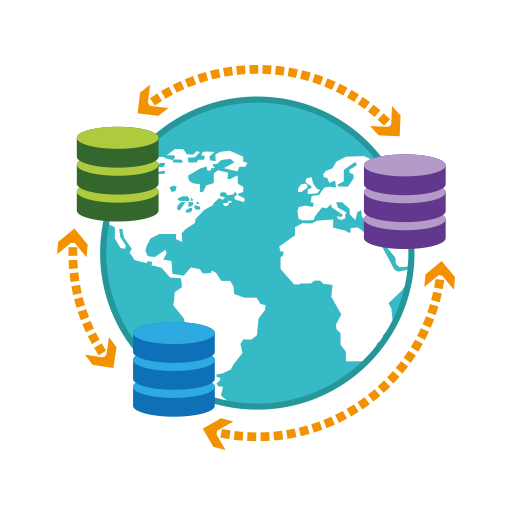
node diagram
By default BDR uses asynchronous replication, applying changes onthe peer nodes only after the local commit. An optionaleager all node replication feature allows for commitingon all nodes using consensus.
Basic Architecture
Multiple Groups
A BDR node is a member of at least one Node Group, and in the mostbasic architecture there is a single node group for the whole BDRcluster.
Multiple Masters
Each node (database) participating in a BDR group both receiveschanges from other members and can be written to directly by the user.
This is distinct from Hot or Warm Standby, where only one masterserver accepts writes, and all the other nodes are standbys thatreplicate either from the master or from another standby.
You don’t have to write to all the masters, all of the time; it’sa frequent configuration to direct writes mostly to just one master.
Asynchronous, by default
Changes made on one BDR node are not replicated to other nodes untilthey
are committed locally. As a result the data is not exactly thesame on
all nodes at any given time; some nodes will have data thathas not yet
arrived at other nodes. PostgreSQL’s block-based replicationsolutions
default to asynchronous replication as well. In BDR,because there are
multiple masters and as a result multiple data streams,data on different
nodes might differ even whensynchronous_commit and
synchronous_standby_names are used.
Mesh Topology
BDR is structured around a mesh network where every node connects to everyother node and all nodes exchange data directly with each other. There is noforwarding of data within BDR except in special circumstances such as nodeaddition and node removal. Data may arrive from outside the BDR cluster orbe sent onwards using native PostgreSQL logical replication.
Logical Replication
Logical replication is a method of replicating data rows and their changes,based upon their replication identity (usually a primary key).We use the term logical in contrast to physical replication, which usesexact block addresses and byte-by-byte replication. Index changes are notreplicated, thereby avoiding write amplification and reducing bandwidth.
Logical replication starts by copying a snapshot of the data from thesource node. Once that is done, later commits are sent to other nodes asthey occur in real time. Changes are replicated without re-executing SQL,so the exact data written is replicated quickly and accurately.
Nodes apply data in the order in which commits were made on the source node,ensuring transactional consistency is guaranteed for the changes fromany single node. Changes from different nodes are applied independently ofother nodes to ensure the rapid replication of changes.
Replicated data is sent in binary form, when it is safe to do so.
High Availability
Each master node can be protected by one or more standby nodes, so any nodethat goes down can be quickly replaced and continue. Each standby node canbe either a logical or a physical standby node.
Replication continues between currently connected nodes even if one or morenodes are currently unavailable. When the node recovers, replicationcan restart from where it left off without missing any changes.
Nodes can run different release levels, negotiating the required protocolsto communicate. As a result, BDR clusters can use rolling upgrades, evenfor major versions of database software.
DDL is automatically replicated across nodes by default. DDL execution canbe user controlled to allow rolling application upgrades, if desired.
Limits
BDR can run hundreds of nodes on good enough hardware and network, howeverfor mesh based deployments it’s generally not recommended to run more than32 nodes in one cluster.Each master node can be protected by multiple physical or logical standby nodes;there is no specific limit on the number of standby nodes,but typical usage would be to have 2-3 standbys per master. Standby nodes don’tadd additional connections to the mesh network so they are not included in the32 node recommendation.
BDR currently has hard limit of no more than 1000 active nodes as this is thecurrent maximum Raft connections allowed.
BDR places a limit that at most 10 databases in any one PostgreSQL instancecan be BDR nodes across different BDR node groups. However BDR works best ifonly one BDR database per PostgreSQL instance is used.
The minimum recommended number of nodes in BDR cluster is 3, because with2 nodes the consensus stops working if one of the node stops working.
Architectural Options & Performance
Characterising BDR performance
BDR can be configured in a number of different architectures, each of which hasdifferent performance and scalability characteristics.
The Group is the basic building block of a BDR Group consisting of 2+ nodes(servers). Within a Group, each node is in a different AZ, with dedicated routerand backup, giving Immediate Switchover and High Availability. Each Group has adedicated Replication Set defined on it. If the Group loses a node it is easilyrepaired/replaced by copying an existing node from the Group.
Adding more master nodes to a BDR Group does not result in significant writethroughput increase when most tables are replicated because BDR has to replayall the writes on all nodes. Because BDR writes are in general more effectivethan writes coming from Postgres clients via SQL, some performance increasecan be achieved. Read throughput generally scales linearly with the number ofnodes.
The following architectures are available:
Multimaster/Single Group
BDR AlwaysOn
The simplest architecture is just to have one Group, so let’s examine that first:
BDR MultiMaster within one Group
By default, BDR will keep one copy of each table on each node in the Group and anychanges will be propagated to all nodes in the Group.
Since copies of data are everywhere, SELECTs need only ever access the local node.On a read-only cluster, performance on any one node will not be affected by thenumber of nodes. Thus adding nodes will increase linearly the total possible SELECTthroughput.
INSERTs, UPDATEs and DELETEs (DML) are performed locally, then the changes willbe propagated to all nodes in the Group. The overhead of DML apply is less than theoriginal execution, so if you run a pure write workload on multiple nodesconcurrently, a multi-node cluster will be able to handle more TPS than a single node.
Conflict handling has a cost that will act to reduce the throughput. The throughputis then dependent upon how much contention the application displays in practice.Applications with very low contention will perform better than a single node;applications with high contention could perform worse than a single node.These results are consistent with any multi-master technology, they are not a facetor peculiarity of BDR.
Eager replication can avoid conflicts, but is inherently more expensive.
Changes are sent concurrently to all nodes so that the replication lag is minimised.Adding more nodes means using more CPU for replication, so peak TPS will reduceslightly as each new node is added.
If the workload tries to uses all CPU resources then this will resource constrainreplication, which could then affect the replication lag.
BDR AlwaysOn
The AlwaysOn architecture is built from 2 Groups, in 2 separate regions. Each Groupprovides HA and IS, but together they also provide Disaster Recovery (DR), so we referto this architecture as AlwaysOn with Very High Availability.
Tables are created across both Groups, so any change goes to all nodes, not just tonodes in the local Group.
One node is the target for the main application. All other nodes are described asshadow nodes (or “read-write replica”), waiting to take over when needed. If a nodeloses contact we switch immediately to a shadow node to continue processing. If aGroup fails, we can switch to the other Group. Scalability is not the goal of thisarchitecture.
Since we write mainly to only one node, the possibility of contention between isreduced to almost zero and as a result performance impact is much reduced.
CAMO is eager replication within the local Group, lazy with regard to other Groups.
Secondary applications may execute against the shadow nodes, though these should bereduced or interrupted if the main application begins using that node.
Future feature: One node is elected as main replicator to other Groups, limiting CPUoverhead of replication as the cluster grows and minimizing the bandwidth to other Groups.
Deployment
BDR is intended to be deployed in one of a small number of known-good configurations,using either TPAexec or a configuration management approachand deployment architecture approved by Technical Support.
Manual deployment is not recommended and may not be supported.
Please refer to the TPAexec Architecture User Manual for your
architecture.
Log messages and documentation are currently available only in English.
Clocks and Timezones
BDR has been designed to operate with nodes in multiple timezones, allowing atruly worldwide database cluster. Individual servers do not need to be configuredwith matching timezones, though we do recommend using log_timezone = UTC toensure the human readable server log is more accessible and comparable.
Server clocks should be synchronized using NTP or other solutions.
Clock synchronization is not critical to performance, as is the case with someother solutions. Clock skew can impact Origin Conflict Detection, thoughBDR provides controls to report and manage any skew that exists. BDR alsoprovides Row Version Conflict Detection, as described in Conflict Detection.