Performing a Schema Extraction
Prerequisites
Before extracting a schema, you must download the latest EDB DDL Extractor script from the Migration Portal Projects page or from the link provided in the DDL Extractor guide in the Portal Wiki.
The script can be run in SQL Developer or SQL*Plus. It uses Oracle’s DBMS_METADATA built-in package to extract DDLs for different objects under schemas (specified while running the script).
The EDB DDL extractor creates the DDL file that will be uploaded to the portal and analyzed for EDB Postgres compatibility.
Note: You must have SELECT CATALOG ROLE and SELECT ANY DICTIONARY privileges in the Oracle database.
For SQL*Plus
Connect to SQL*Plus and run the command:
SQL>@edb_ddl_extractor.sqlProvide the schema name and the pathdirectory in which the extractor will store the extracted DDL. When extracting multiple schemas, use a comma (‘,’) as a delimiter.
If you want to extract dependent objects from other schemas, enter
yesorno.For example, on Linux:
Enter SCHEMA NAME[S] to extract DDLs:HR, SCOTT, FINANCEEnter the PATH to store DDL file:/home/oracle/extracted_ddls/Extract dependent objects from other schemas? (yes/no): yesOn Windows:
Enter SCHEMA NAME[S] to extract DDLs:HR, SCOTT, FINANCEEnter the PATH to store DDL file:C:\Users\Example\Desktop\Extract dependent objects from other schemas? (yes/no): yes
For SQL Developer
Connect to the SQL server and run the following command:
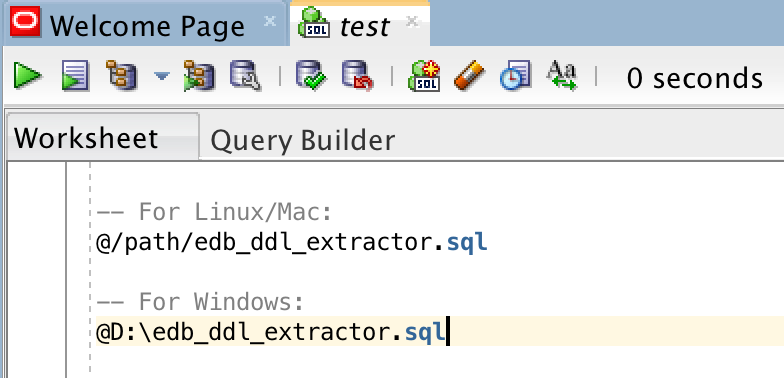
Enter the path for Linux or Windows.
Enter a comma-separated list of schemas:
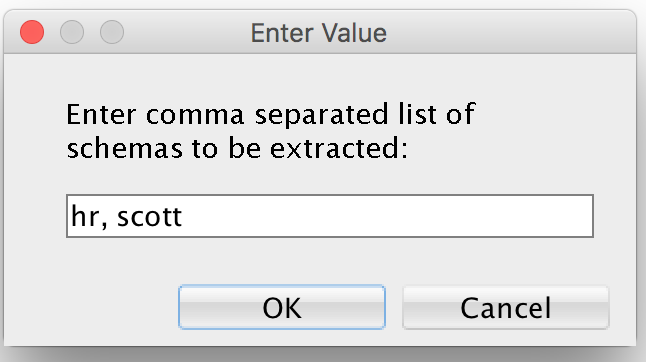
Provide a list of schemas.
Enter file path for the output file:
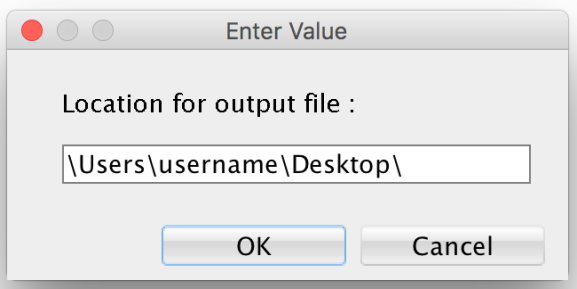
Specify the output file path.
Extract dependent objects from other schemas?(yes/no): yes
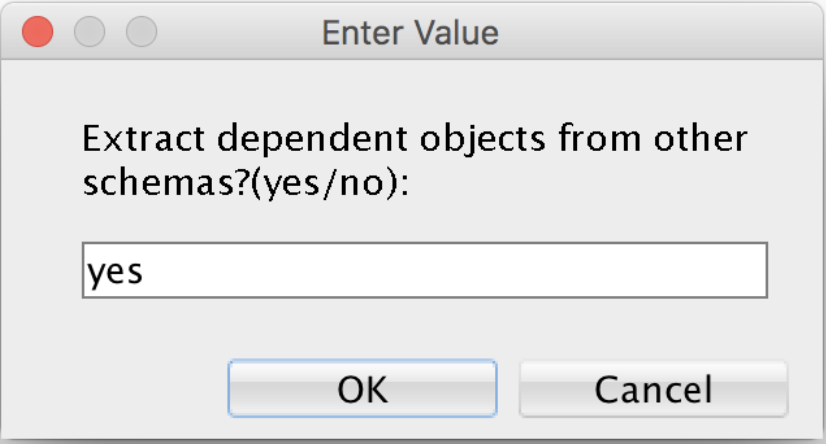
Extracting dependent objects.
Note: You can also enter a single schema name in both SQL*Plus and SQL Developer tools.
The script iterates through the object types in the source database and once the task is completed, the .SQL output is stored at the entered location, i.e.,
c:\Users\Example\Desktop\.
Additional Notes - The EDB DDL Extractor does not extract objects that have names like:
BIN$b54+4XIEYwPgUAB/AQBWwA= =$0To extract these objects, you must change the name of the objects and re-run the extraction process.
DDL Extractor extracts
nologgingtables as normal tables. Once these tables are migrated to Advanced Server, WAL log files will be created.
Supported Object Types
The migration portal supports the migration of the following object types:
Synonyms
DB Links
Types and Type Body
Sequences
Tables
Constraints
Indexes (Except LOB indexes and indexes on materialized views)
Views
Materialized Views
Triggers
Functions
Procedures
Packages