Schema migration
After resolving errors in your schemas, you can use the schemas with a client application such as pgAdmin, Toad Edge, or the PSQL client. Or you can migrate the schema to an EDB Postgres Advanced Server.
You can migrate to any of these schemas:
Existing on-premises EDB Postgres Advanced Server
New on-premises EDB Postgres Advanced Server
EDB Postgres Advanced Server in the cloud
Migrating to an existing on-premises EDB Postgres Advanced Server host
You can migrate schemas to an existing on-premises EDB Postgres Advanced Server on Windows or Linux platforms.
Migrate schemas on Windows
Select Existingon-premisesEDBPostgresPostgresAdvancedServer .
Select one or more schemas to migrate to EDB Postgres Advanced Server. You can also expand a schema and select specific object types under each schema.
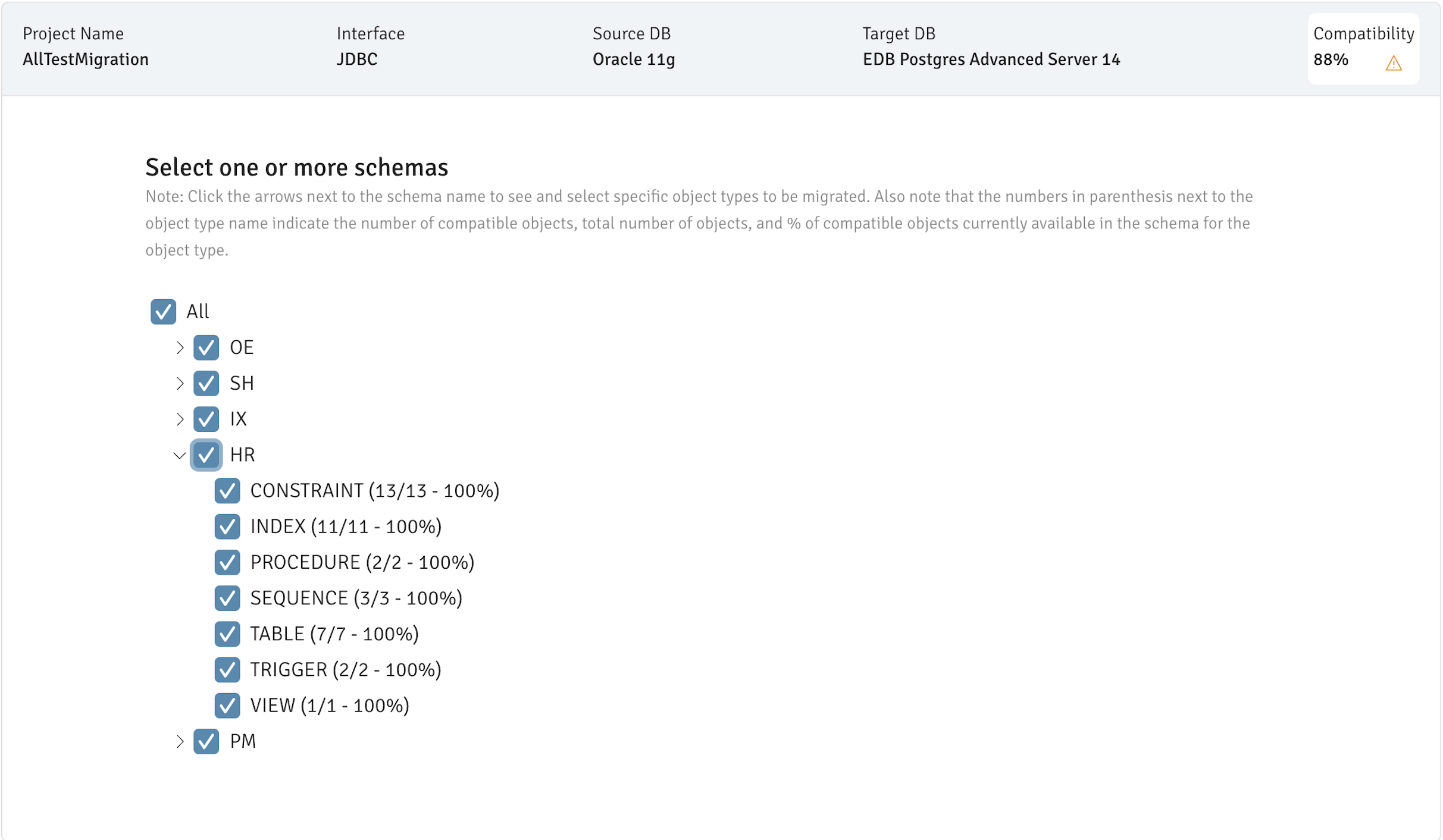
!!!Note If your schemas aren’t 100% compatible, a banner appears. Complete the Contact Us form as needed.
To download the assessed schemas, select DownloadSQLfile .
Extract the downloaded zip file. The zip package consists of SQL files with DDLs for your selected schemas and objects. The DDLs are grouped in SQL files by project, schemas, or objects.
SQL file naming convention |
Description |
Example |
|---|---|---|
<ProjectName> _ALL_OBJECTS.sql |
A single consolidated file consisting of DDLs for all your selected schemas and objects. |
AllTestMigration_ALL_OBJECTS.sql will consist of DDLs for all objects of schemas OE, SH, IX, and PM, and only selected objects of schema HR. |
<SchemaName> .sql |
One or more files, each consisting of DDLs for selected objects in a particular schema. |
HR.sql will consist of DDLs for all the selected objects of the HR schema. |
<SchemaName> _ <ObjectType> .sql |
One or more files, each consisting of DDLs for a single selected object. |
HR_TABLE.sql will consist of DDLs only for TABLE object of the HR schema. |
Select Windows .
To import the schemas, run:
On CLI:
\i c:\users\...\<sql_file_name>.sql
- On cmd/shell:
edb-psql -f <sql_file_name>.sql
Note
You can alternatively use the pgAdmin client for the import.
The converted schemas migrate to the target server.
Migrate schemas on Linux
You can migrate schemas to an existing on-premises EDB Postgres Advanced Server on Linux.
Select Existingon-premisesEDBPostgresAdvancedServer .
Select one or more schemas to migrate to EDB Postgres Advanced Server. You can also expand a schema and select specific object types under each schema.
To download the assessed schemas, select DownloadSQLfile .
Extract the downloaded zip file. The zip package consists of SQL files with DDLs for your selected schemas and objects. The DDLs are grouped in SQL files by project, schemas, or objects.
SQL file naming convention |
Description |
Example |
|---|---|---|
<ProjectName> _ALL_OBJECTS.sql |
A single consolidated file consisting of DDLs for all your selected schemas and objects. |
AllTestMigration_ALL_OBJECTS.sql will consist of DDLs for all objects of schemas OE, SH, IX, and PM, and only selected objects of schema HR. |
<SchemaName> .sql |
One or more files, each consisting of DDLs for selected objects in a particular schema. |
HR.sql will consist of DDLs for all the selected objects of the HR schema. |
<SchemaName> _ <ObjectType> .sql |
One or more files, each consisting of DDLs for a single selected object. |
HR_TABLE.sql will consist of DDLs only for TABLE object of the HR schema. |
Select Linux .
To import the schemas, invoke the following
edb-psqlclient commands:
sudo su - enterprisedb
edb-psql edb
create database <database_name>;
\connect <database_name>
\i <sql_file_name>.sql
Note
You can alternatively use the pgAdmin client for the import.
The converted schemas migrate to the target server.
Migrating to a new on-premises EDB Postgres Advanced Server installation
You can install new EDB Postgres Advanced Server on premises on Windows or Linux platforms and migrate the schemas.
Migrate schemas on Windows
Migrate schemas to a new on-premises EDB Postgres Advanced Server on Windows.
Select Newon-premisesEDBPostgresPostgresAdvancedServer .
Select one or more schemas to migrate to EDB Postgres Advanced Server. You can also expand a schema and select specific object types under each schema.
For the operating system, select Windows .
Select DownloadWindowsinstaller .
For installation steps, select EDBPostgresAdvancedServerInstallationGuideforWindows .
To download the assessed schemas, select DownloadSQLfile .
Extract the downloaded zip file. The zip package consists of SQL files with DDLs for your selected schemas and objects. The DDLs are grouped in SQL files by project, schemas, or objects.
SQL file naming convention |
Description |
Example |
|---|---|---|
<ProjectName> _ALL_OBJECTS.sql |
A single consolidated file consisting of DDLs for all your selected schemas and objects. |
AllTestMigration_ALL_OBJECTS.sql will consist of DDLs for all objects of schemas OE, SH, IX, and PM, and only selected objects of schema HR. |
<SchemaName> .sql |
One or more files, each consisting of DDLs for selected objects in a particular schema. |
HR.sql will consist of DDLs for all the selected objects of the HR schema. |
<SchemaName> _ <ObjectType> .sql |
One or more files, each consisting of DDLs for a single selected object. |
HR_TABLE.sql will consist of DDLs only for TABLE object of the HR schema. |
You can import schemas by running:
On CLI
\i c:\users\...\<sql_file_name>.sql
- On cmd/shell
edb-psql -f <sql_file_name>.sql
Note
You can alternatively use the pgAdmin client for the import.
Migrate schemas on Linux
Migrate schemas to an on-premises EDB Postgres Advanced Server on Linux.
Select NewOn-premisesEDBPostgresAdvancedServer .
Select one or more schemas to migrate to EDB Postgres Advanced Server. You can also expand a schema and select specific object types under each schema.
For the operating system, select Linux .
You can select one of the following options to install the EDB Postgres Advanced Server:
Repository - More options
For information on the installation procedure, select EDBPostgresAdvancedServerInstallationGuide for Linux.
To download the assessed schemas, select DownloadSQLfile .
Extract the downloaded zip file. The zip package consists of SQL files with DDLs for your selected schemas and objects. The DDLs are grouped in SQL files by project, schemas, or objects.
SQL file naming convention |
Description |
Example |
|---|---|---|
<ProjectName> _ALL_OBJECTS.sql |
A single consolidated file consisting of DDLs for all your selected schemas and objects. |
AllTestMigration_ALL_OBJECTS.sql will consist of DDLs for all objects of schemas OE, SH, IX, and PM, and only selected objects of schema HR. |
<SchemaName> .sql |
One or more files, each consisting of DDLs for selected objects in a particular schema. |
HR.sql will consist of DDLs for all the selected objects of the HR schema. |
<SchemaName> _ <ObjectType> .sql |
One or more files, each consisting of DDLs for a single selected object. |
HR_TABLE.sql will consist of DDLs only for TABLE object of the HR schema. |
To import the schemas, run:
sudo su - enterprisedb
edb-psql edb
create database <database_name>;
\connect <database_name>
\i <sql_file_name>.sql
Note
You can alternatively use the pgAdmin client for the import.
The converted schemas migrate to the target server.
Migrate to the cloud
Migrate schemas on EDB Postgres Advanced Server to the cloud.
Select EDBPostgresAdvancedServeronCloud .
Select one or more schemas to migrate to EDB Postgres Advanced Server. You can also expand a schema and select specific object types under each schema.
Select the cloud platform, for example, BigAnimal .
To launch a new cluster, select GotoBigAnimal . Or, if you have an existing cluster running, select Next .
Note
See the Big Animal page for more information.
Enter the required connection details on the
Connectpage.

Connecting to the cloud cluster
To verify the connection details, select TestConnection .
Note
You can select Edit Connection to make changes to the connection details and retest the connection details.
Once the connection is successful, select Next .
The converted schemas migrate to the target server.