
Creating Raft subgroups using TPA#
The TPAexec configure command enables Raft subgroups if the
--enable_proxy_routing local option is set. TPA uses the term
locations to reflect the common use case of subgroups that map to
physical/regional domains. When the configuration is generated, the
location name given is stored under the generated group name, which is
based on the location name.
Creating Raft subgroups using TPA#
This example creates a two-location cluster with three data nodes in each location. The nodes in each location are part of a PGD Raft subgroup for the location.
The top-level group’s name is pgdgroup .
The top-level group has two locations: us_east and us_west .
These locations are mapped to two subgroups: us_east_subgroup and
us_west_subgroup .
Each location has four nodes: three data nodes and a barman backup node. The three data nodes also cohost PGD Proxy. The configuration can be visualized like so:
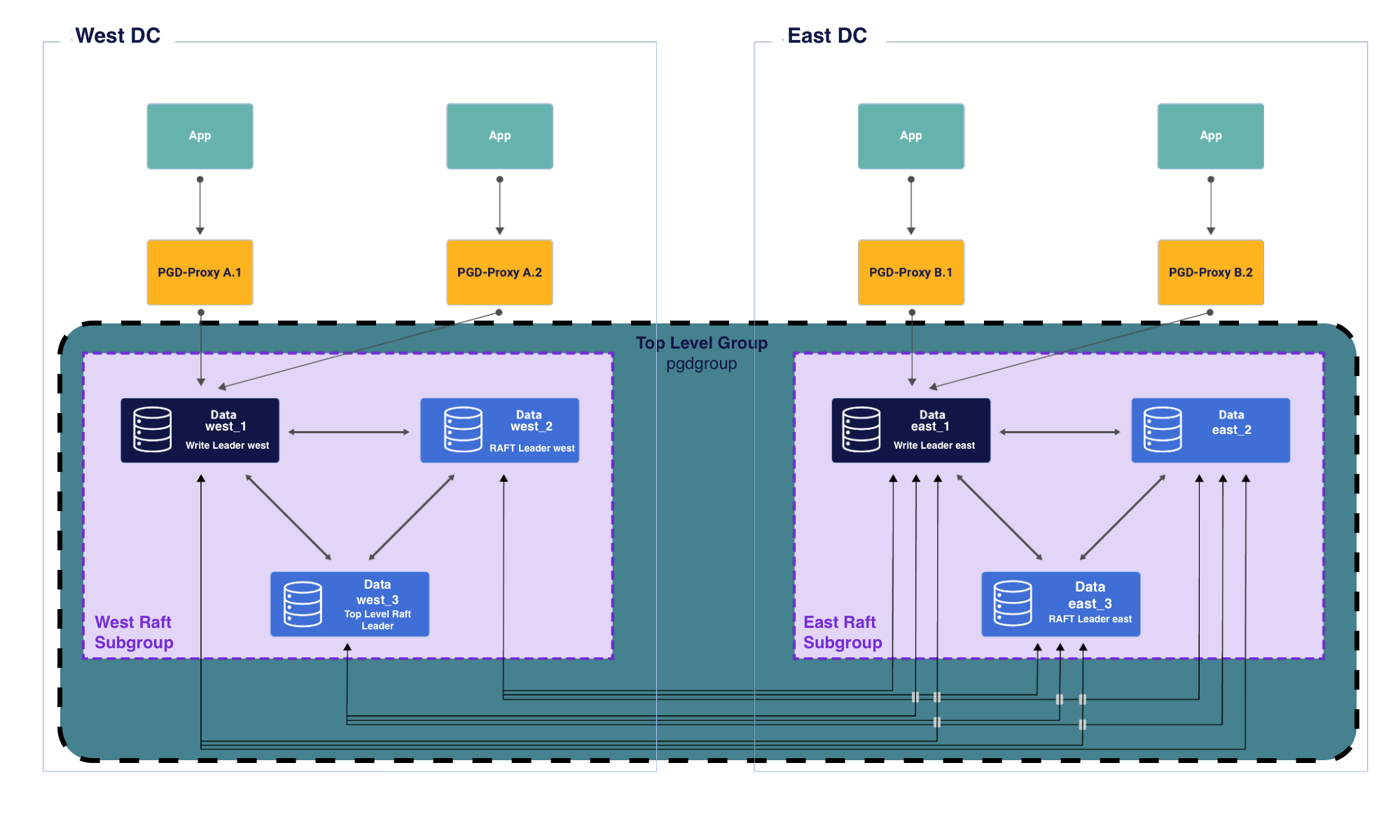
6 Node Cluster with 2 Raft Subgroups#
The barman nodes don’t participate in the subgroup and, by extension, the Raft group. They’re therefore not shown. This diagram is a snapshot of a potential state of the cluster with the West Raft group having selected west_1 as write leader and west_2 as its own Raft leader. On the East, east_1 is write leader while east_3 is Raft leader. The entire cluster is contained within the top-level Raft group. There, west_3 is currently Raft leader.
To create this configuration, you run:
tpaexec configure pgdgroup --architecture PGD-Always-ON --location-names us_east us_west --data-nodes-per-location 3 --epas 15 --no-redwood --enable_proxy_routing local --hostnames-from hostnames.txt
Where hostnames.txt contains:
east1
east2
east3
eastbarman
west1
west2
west3
westbarman
The configuration file#
The generated config.yml file has a bdr_node_groups section that
contains the top-level group pgdgroup and the two subgroups
us_east_subgroup and us_west_subgroup . Each of those subgroups
has a location set (us_east and us_west ) and two other options
that are set to true:
enable_raft, which activates the subgroup Raft in the subgroupenable_proxy_routing, which enables the pgd_proxy routers to route traffic to the subgroup’s write leader
Here’s an example generated by the sample tpaexec command:
cluster_vars:
  apt_repository_list: []
  bdr_database: bdrdb
  bdr_node_group: pgdgroup
  bdr_node_groups:
  - name: pgdgroup
  - name: us_east_subgroup
    options:
      enable_proxy_routing: true
      enable_raft: true
      location: us_east
    parent_group_name: pgdgroup
  - name: us_west_subgroup
    options:
      enable_proxy_routing: true
      enable_raft: true
      location: us_west
    parent_group_name: pgdgroup
  bdr_version: 5
Every node instance has an entry in the instances list. In that entry,
bdr_child_group appears in the variables section, set to the
subgroup the node belongs to. Here’s an example generated by the sample
tpaexec command:
instances:

- Name: east1
  backup: eastbarman
  location: us_east
  node: 1
  role:
  - bdr
  - pgd-proxy
  vars:
    bdr_child_group: us_east_subgroup
    bdr_node_options:
      route_priority: 100

- Name: east2
  location: us_east
  node: 2
  role:
  - bdr
  - pgd-proxy
  vars:
    bdr_child_group: us_east_subgroup
    bdr_node_options:
      route_priority: 100

- Name: east3
  location: us_east
  node: 3
  role:
  - bdr
  - pgd-proxy
  vars:
    bdr_child_group: us_east_subgroup
    bdr_node_options:
      route_priority: 100

- Name: eastbarman
  location: us_east
  node: 4
  role:
  - barman
The one node in this location that doesn’t have a bdr_child_group
setting is the barman node because it doesn’t participate in the Raft
decision-making process.